Dental X-Ray Machine Types: CBCT vs Panoramic vs Intraoral
Published: April 23, 2026 | Author: Mayamed Editorial Team | Category: Medical Imaging Equipment
# Dental X-Ray Machine Types: CBCT vs Panoramic vs Intraoral
Summary: Navigating the dental x-ray machine market requires more than comparing price tags. This procurement-focused guide breaks down the clinical applications, technical specifications, and ROI of CBCT, panoramic, and intraoral systems. Designed for clinic directors and purchasing managers, it delivers actionable insights to align imaging investments with patient volume, diagnostic needs, and regional infrastructure realities.Introduction
The transition from analog film to advanced digital imaging has fundamentally transformed dental diagnostics. Yet, for procurement teams, selecting the right dental x-ray machine remains a complex balancing act between clinical capability, workflow efficiency, and long-term operational costs. Whether you’re equipping a high-volume urban practice or expanding a regional dental center, understanding the distinct advantages of each modality is critical. This guide provides a structured, specification-driven product comparison to support your buying decision guide and ensure your capital investment delivers measurable diagnostic value and patient safety.
Clinical Modality Breakdown: CBCT vs Panoramic vs Intraoral
Intraoral Sensors: High-Resolution Chairside Diagnostics
Intraoral imaging remains the gold standard for caries detection, endodontic assessment, and periodontal bone evaluation. Modern CMOS and PSP intraoral sensor systems deliver spatial resolutions of 14–20 line pairs/mm with a Detective Quantum Efficiency (DQE) exceeding 0.70, significantly reducing patient radiation exposure compared to traditional film. With near-instantaneous image transfer via USB/Wi-Fi, chairside turnaround time drops from minutes to seconds, enabling immediate treatment adjustments during procedures like root canal therapy or crown preparation.Panoramic X-Ray: Comprehensive Extraoral Screening
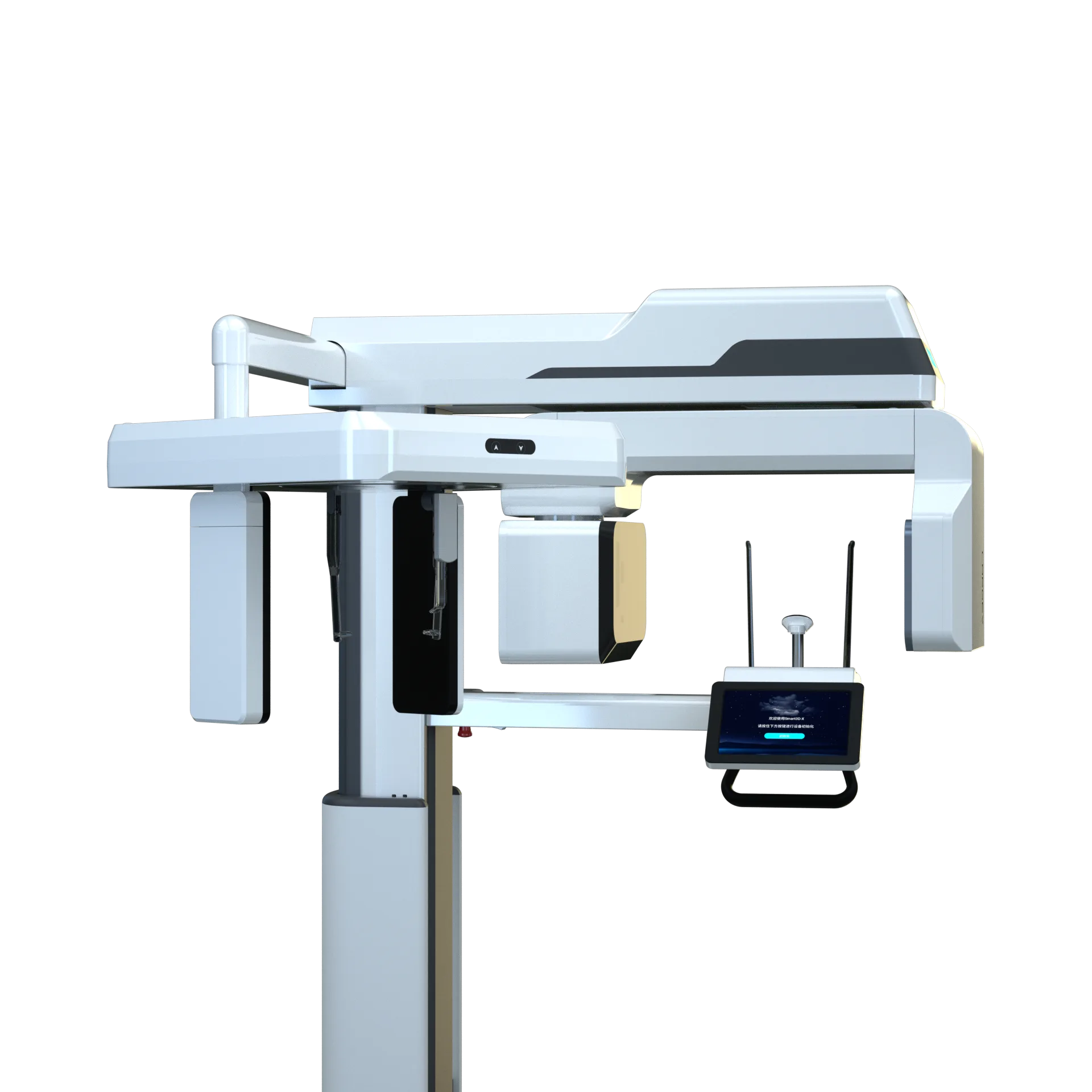
A panoramic x-ray unit captures a single, wide-field 2D image of the maxilla, mandible, and dentition. Operating typically at 60–90 kVp with 2–8 mA tube currents and 10–15 second exposure times, these systems excel in orthodontic planning, impacted tooth localization, and TMJ screening. Advanced models now feature cephalometric add-ons and panoramic stitching algorithms that minimize anatomical distortion. For facilities managing high ortho or pediatric volumes, a dedicated panoramic system offers an optimal balance of throughput and diagnostic coverage.Cone Beam CT (CBCT) for Dentists: 3D Volumetric Imaging
For surgical planning and implantology, the cone beam ct dentist workflow has become indispensable. CBCT systems generate isotropic 3D datasets with voxel resolutions ranging from 0.076 mm to 0.4 mm, allowing clinicians to assess bone density, nerve canal trajectories, and sinus anatomy with sub-millimeter precision. Selectable field-of-view (FOV) options (from 5×5 cm for localized endodontics to 23×17 cm for full-arch reconstruction) enable dose-optimized scanning. While upfront costs are higher, CBCT delivers strong ROI through surgical guide fabrication, complex extractions, and reduced referral leakage.Digital vs. Analog: Workflow & Cost Analysis
| Parameter | Digital Radiography (DR/PSP) | Analog Film-Based | |:---|:---|:---| | Spatial Resolution | 14–20 lp/mm (adjustable post-processing) | 12–15 lp/mm (fixed, limited by emulsion) | | DQE & Dynamic Range | 0.65–0.80; 16-bit grayscale depth | 0.25–0.35; ~8-bit limited contrast | | Workflow Turnaround | 3–10 seconds; instant preview & enhancement | 10–15 minutes; chemical processing & drying | | Storage & Integration | Cloud/PACS archiving, DICOM 3.0 compliant | Physical cabinets, manual filing, retrieval delays | | Cost Per Image | $0.50–$2.00 (negligible consumables) | $20–$45 (film, developer, fixer, disposal) | | Patient Dose Reduction | 40–70% lower mAs requirements | Standard exposure protocols |
Fixed vs. Portable System Configurations
Fixed Installations:- Clinical Advantage: Superior tube heat capacity (typically >200 kHU), consistent geometric alignment, and ceiling/wall mounting that optimizes operator ergonomics.
- Operational Fit: Ideal for high-volume clinics (>30 patients/day) requiring automated exposure control, integrated bite-positioning lasers, and seamless PACS integration.
- Infrastructure Note: Requires dedicated 15–20A circuits, lead-lined walls, and stable floor anchoring.
- Clinical Advantage: Battery-operated or low-draw designs (<1500W peak), foldable arms, and lightweight chassis (<15 kg) enable multi-chair or mobile clinic deployment.
- Operational Fit: Best suited for space-constrained practices, field screenings, or satellite locations where permanent installation isn't feasible.
- Trade-off Considerations: Lower duty cycles and reduced tube cooling capacity require strategic scheduling to prevent overheating during peak hours.
Technical Specifications & International Compliance
Procurement teams must verify that imaging equipment meets stringent performance and safety benchmarks. Key parameters to validate during vendor evaluation include:
- Generator Stability: kVp accuracy ±1%, mA linearity ±2%, exposure time precision ±5% (0.01s–15s range)
- Focal Spot Size: 0.4–0.7 mm (standard) or 0.3 mm (micro-focus) for enhanced edge sharpness
- Software Ecosystem: Native DICOM 3.0 compatibility, PACS/EMR integration, AI-assisted caries & lesion detection modules
- Radiation Safety: Automatic Exposure Control (AEC), beam filtration ≥1.5 mm Al equivalent, compliance with IEC 60601-1 & IEC 60601-2-65
All reputable systems should carry ISO 13485:2016 quality management certification, CE (MDR 2017/745) marking for EU compliance, and FDA 510(k) clearance for North American markets. Verify that software updates, calibration tools, and service documentation are available in your region’s primary language.
Infrastructure Adaptation for Emerging Markets
Deploying imaging technology in Africa, Latin America, and the Middle East demands hardware engineered for variable grid conditions and challenging climates. Mayamed’s regional deployment strategy includes:
- Power Grid Resilience: Wide-input voltage tolerance (100–240V AC ±15%, 50/60Hz) with integrated automatic voltage regulation (AVR) and Class B surge suppression to prevent generator-induced tube failures.
- Thermal Management: Closed-loop forced-air cooling and high-capacity heat exchangers rated for continuous operation in ambient temperatures up to 45°C (113°F), with thermal throttling safeguards to protect detector arrays.
- Environmental Sealing: IP54-rated control panels and detector housings with anti-static dust filters and conformal-coated PCBs to mitigate humidity (up to 90% RH) and particulate ingress common in arid or coastal installations.
- Logistics & Service Readiness: Modular packaging optimized for 20ft/40ft container shipping, localized calibration kits, and remote diagnostic telemetry to minimize mean-time-to-repair (MTTR) where field engineers are scarce.
Procurement Strategy & Implementation Support
Selecting a dental x-ray machine isn’t a one-time purchase; it’s a long-term partnership. Evaluate vendors based on total cost of ownership (TCO), including detector replacement cycles, software licensing, warranty response times, and training programs. Prioritize suppliers who offer site planning assistance, radiation safety documentation, and phased installation support tailored to your facility’s workflow.
🚀 Ready to Upgrade Your Imaging Department?
With 10+ years of specialized export experience and active deployments across 50+ countries, Mayamed delivers clinically proven dental imaging systems engineered for global reliability and cost efficiency.
- ✅ Free Technical Consultation & Site Planning – Layout optimization, power/load calculations, and radiation shielding guidance
- ✅ Comprehensive Warranty & Remote Diagnostics – 2–3 year coverage, live support, and over-the-air firmware updates
- ✅ Fast Global Logistics & On-Site Commissioning – DDP shipping options, multilingual manuals, and certified installation training
[📩 Request a Quote] | [📞 Contact Global Support]