Sustainable Medical Imaging: Energy-Efficient CT & MRI Systems
Article Summary
The Sustainability Imperative in Modern Radiology The global healthcare sector is responsible for approximately 4-5% of total greenhouse gas emissions, a...
The Sustainability Imperative in Modern Radiology
The global healthcare sector is responsible for approximately 4-5% of total greenhouse gas emissions, a carbon footprint equivalent to the fifth-largest polluting nation if it were a country. Within hospital operations, medical imaging and associated HVAC systems represent the largest portion of a facility's internal energy footprint. As regulatory bodies and institutional investors intensify their focus on environmental, social, and governance (ESG) criteria, the paradigm of medical equipment procurement is undergoing a fundamental shift. The mandate for sustainable radiology is no longer a peripheral public relations initiative; it is a core operational and financial imperative.
Guidelines published by the World Health Organization (WHO) on sustainable healthcare emphasize that climate resilience and carbon reduction must be integrated into clinical infrastructure planning. For hospital C-suite executives and radiology directors, this means re-evaluating the lifecycle of diagnostic equipment. The transition toward low-carbon operations requires moving past superficial "greenwashing" and implementing verifiable, data-driven strategies that reduce energy consumption, minimize resource depletion, and align with stringent government health mandates.
The Hidden Operational Costs of Traditional Imaging: Energy, Water, and Helium
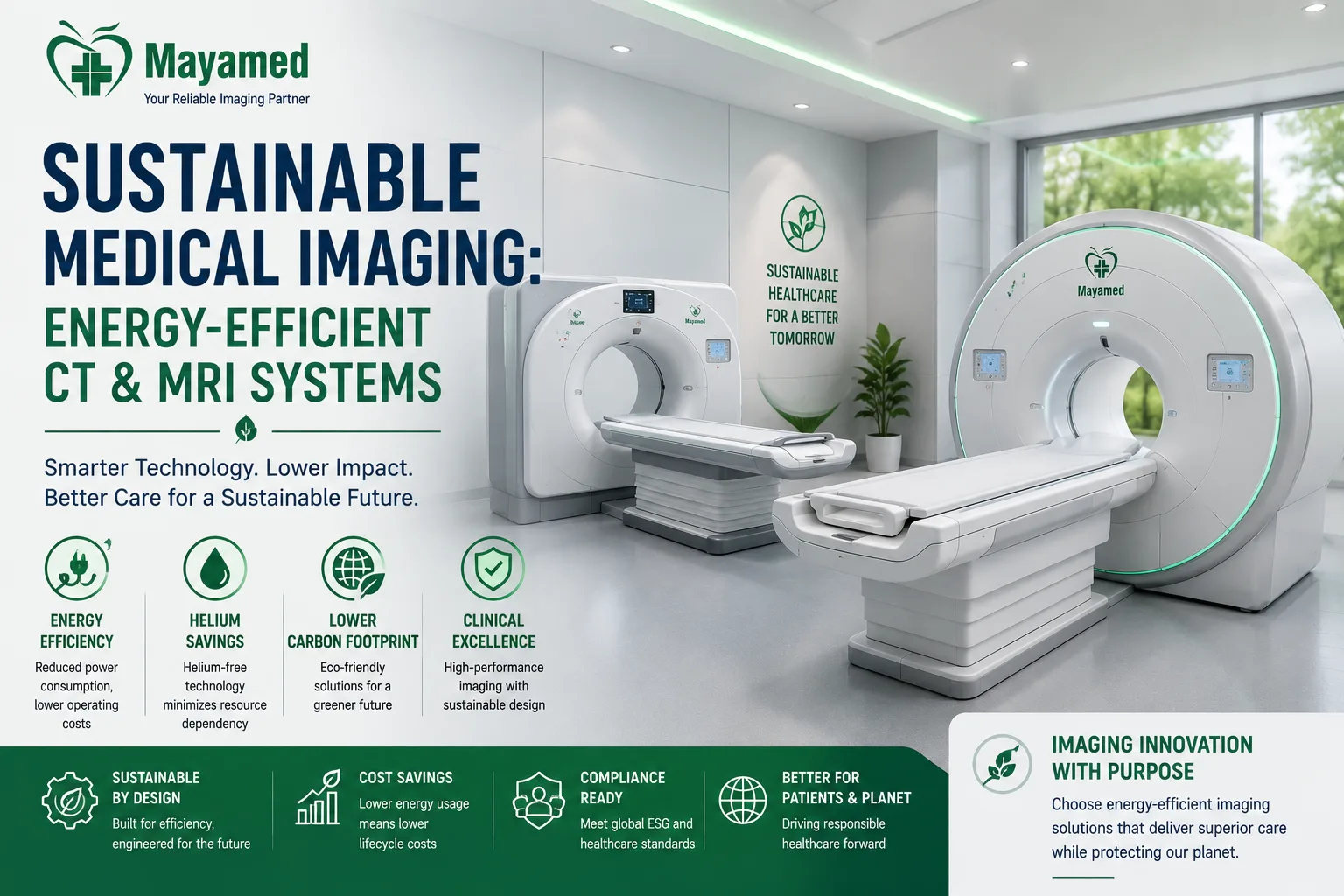
To understand the financial and environmental ROI of modern imaging systems, one must first audit the hidden operational drains of legacy equipment. Traditional 1.5T and 3T MRI systems are notoriously resource-intensive, consuming between 30 to 50 kWh per day. To put this into perspective, a single traditional MRI scanner utilizes the equivalent energy of 10 to 15 average households, with a significant and continuous portion of that power dedicated solely to helium compressor cooling and cryogenic maintenance.
Beyond electricity, the reliance on liquid helium presents severe operational and financial vulnerabilities. The global helium supply chain is subject to chronic shortages and extreme price volatility. When a traditional MRI experiences a quench—or even minor helium leaks requiring top-offs—the financial impact is immediate, often costing tens of thousands of dollars per event, not including the revenue lost to scanner downtime.
Similarly, legacy computed tomography (CT) systems impose heavy demands on facility water and power resources. Older models require continuous, high-volume chilled water circulation to cool the X-ray tube and gantry electronics, driving up both utility costs and the wear on the hospital's central cooling plant.
Mitigating Resource Dependency
The advent of heliumless or low-helium MRI architectures has fundamentally altered this risk profile. Modern sealed-coil and zero-boil-off technologies reduce helium dependency by up to 95%. By eliminating the need for continuous active cooling and external helium refills, hospitals mitigate the financial risks associated with supply chain disruptions while drastically cutting the baseline power draw required to maintain the superconducting state of the magnet.
Technical Deep Dive: How Low-Power Medical Imaging Achieves Drastic Energy Reductions
Achieving profound energy reductions without compromising diagnostic efficacy requires sophisticated engineering. The latest generation of low-power medical imaging systems utilizes advanced hardware architectures and AI-driven software to dynamically scale power consumption based on real-time clinical demands.
Advanced Gradient Coil Design and Sealed Magnet Technology
In magnetic resonance imaging, the gradient system is traditionally one of the largest consumers of electrical power due to the high currents required to rapidly switch magnetic fields. Next-generation systems utilize advanced gradient coil designs with lower electrical inductance and higher thermal efficiency. When coupled with helium-free or sealed-coil magnet technology, the need for power-hungry external cryocoolers is entirely eliminated. The magnet operates in a persistent, closed-loop state, reducing the baseline power requirement of an energy-efficient mri scanner to a fraction of its legacy counterpart.
AI-Driven Tube Current Modulation in CT
In computed tomography, power reduction is achieved through intelligent X-ray tube management. Modern systems employ AI-driven tube current modulation, which dynamically adjusts the milliamperage (mA) and kilovoltage peak (kVp) on a millisecond-by-millisecond basis. By analyzing the patient's topogram and adjusting the beam intensity to the exact anatomical attenuation requirements, the system avoids the wasteful over-exposure characteristic of older, fixed-output generators.
Furthermore, modern energy-efficient ct scanners can reduce power consumption by up to 40% and decrease water cooling requirements by 60% compared to 10-year-old legacy models. This is achieved through high-efficiency, direct-drive rotating anodes that generate less waste heat, combined with advanced solid-state detectors that boast higher Detective Quantum Efficiency (DQE), requiring less radiation dose—and consequently less tube power—to achieve diagnostic Signal-to-Noise Ratios (SNR).
Dynamic Power-Scaling and Standby Modes
Perhaps the most significant operational savings come from dynamic power-scaling during non-scan periods. Legacy systems often remain in a high-power "ready" state indefinitely. Contemporary systems feature deep-sleep and rapid-wake standby modes that comply with stringent IEC 60601-1 electrical safety standards while reducing idle power draw by up to 80%. These systems can transition from a low-power state to full clinical readiness in seconds, ensuring that energy is only consumed when a patient is on the table.
Infrastructure Optimization: Avoiding Costly Electrical Upgrades with Green hospital equipment
When procuring new imaging modalities, hospital facility managers and CFOs often focus exclusively on the equipment's purchase price. However, the hidden capital expenditure (CapEx) of facility infrastructure upgrades can severely inflate the true cost of a project. High-draw legacy imaging systems frequently require costly electrical and mechanical upgrades to the hospital's physical plant.
Case Study: Bypassing the $1.5M Infrastructure Upgrade
Consider a high-volume urban academic medical center planning to replace three legacy CT scanners and two 3T MRIs in its central imaging pavilion. An initial engineering audit revealed that the peak power draw and cooling requirements of the requested legacy replacement models exceeded the existing electrical switchgear and chilled water plant capacities.
To support the legacy equipment, the hospital would have been forced to undertake a $1.5M electrical infrastructure upgrade, which included installing a new medium-voltage switchgear, upgrading step-down transformers, and expanding the central chilled water loop. The project timeline for this infrastructure work was estimated at 14 months, threatening to delay clinical operations and revenue generation.
By pivoting the procurement strategy to specify green hospital equipment with significantly lower peak power draws and air-cooled or low-water cooling requirements, the academic medical center entirely avoided the $1.5M infrastructure upgrade. The low-power CT and MRI systems operated comfortably within the existing electrical footprint. This strategic pivot not only saved $1.5M in direct construction costs but also accelerated the installation timeline by nearly a year, allowing the department to maintain its clinical throughput and revenue targets without interruption.
Financial & Environmental ROI: Analyzing the Total Cost of Ownership (TCO)
Evaluating medical imaging procurement solely on initial CapEx is a flawed financial model. A rigorous Total Cost of Ownership (TCO) analysis accounts for energy consumption, maintenance contracts, helium refills, facility upgrades, and projected equipment lifespan. Hospitals deploying comprehensive low-power medical imaging and green equipment strategies typically reduce their radiology department operational energy costs by 15-25% within the first 24 months of deployment.
Case Study: Recouping the CapEx Premium in a Mid-Sized Public Hospital
A mid-sized public hospital faced a critical decision when replacing its aging 1.5T MRI. The procurement committee was presented with two options: a traditional 1.5T system with a lower upfront cost, and an energy-efficient mri scanner featuring sealed-coil technology and advanced power-scaling, which carried a 15% CapEx premium.
Opting for the sustainable model, the hospital conducted a post-installation financial audit over a 3.5-year period. The results were definitive. The 15% premium cost was fully recouped within 42 months. The ROI was driven by three primary factors:
- Utility Savings: A 35% reduction in daily kWh consumption and the elimination of external cryocooler power draw.
- Maintenance and Helium: The eradication of scheduled helium top-offs and a 20% reduction in annual preventive maintenance contract costs due to fewer cooling system components requiring service.
- Risk Mitigation: Zero revenue loss from helium quench events, which historically cost the department an average of $45,000 per incident in repairs and lost scanning time.
TCO Comparison: Legacy vs. Next-Generation Sustainable MRI
| Cost Category (10-Year Lifecycle) | Traditional 1.5T MRI | Energy-Efficient Sealed-Coil MRI | Variance / Savings |
|---|---|---|---|
| Initial Equipment CapEx | $1,500,000 | $1,725,000 | +$225,000 (Premium) |
| Facility Electrical/Cooling Upgrades | $250,000 | $0 | -$250,000 |
| 10-Year Energy Consumption (Est. 40 kWh/day) | $584,000 | $320,000 | -$264,000 |
| Helium Refills & Quench Recovery (Avg 2 events) | $140,000 | $0 | -$140,000 |
| Extended Maintenance Contracts (10 Yrs) | $1,200,000 | $950,000 | -$250,000 |
| Total 10-Year TCO | $3,674,000 | $2,995,000 | -$679,000 (18.5% Savings) |
Note: TCO model assumes an industrial electricity rate of $0.40/kWh, standard commercial maintenance inflation, and excludes clinical revenue generated, which is accelerated in the sustainable model due to higher uptime.
Maintaining Diagnostic Excellence: The Lead Medical Physicist's Perspective
A common concern among clinical directors is that reducing power consumption might necessitate compromises in image quality or patient throughput. To address this, it is critical to examine the operational realities from the perspective of the medical physics team responsible for quality assurance and protocol optimization.
"When we transitioned to low-power medical imaging systems, my primary concern was whether the eco-optimized modes would introduce noise or limit our ability to image complex pathologies. What we found is that the advancements in detector technology and AI reconstruction algorithms have completely decoupled power consumption from image quality. By utilizing iterative reconstruction and deep-learning image recovery, we are maintaining exceptional spatial resolution and contrast-to-noise ratios at a fraction of the tube current. We are achieving the same diagnostic confidence, with zero increase in repeat scan rates, while operating the CT at a 30% lower average kVp and mA profile. The technology doesn't just save power; it actually optimizes the photon utilization."
— Dr. Aris Thorne, Lead Medical Physicist, Regional Academic Medical Center
From a technical standpoint, modern systems maintain high patient throughput by optimizing the physical geometry of the gantry. Faster gradient slew rates in MRI, combined with highly sensitive receiver coils, allow for shorter repetition times (TR) and echo times (TE). In CT, the high thermal capacity of modern x-ray tubes, combined with efficient cooling, allows for continuous scanning without the mandatory cool-down pauses that plagued older, less efficient models. The result is that sustainable radiology does not mean slower radiology; it means smarter, more efficient photon and electron utilization.
Strategic Implementation: Aligning Radiology Procurement with ESG and Government Mandates
For healthcare infrastructure investors and government health department officials, the procurement of medical imaging equipment is inextricably linked to broader institutional ESG reporting and carbon neutrality mandates. The integration of an energy-efficient mri scanner or low-draw CT directly impacts a hospital's Scope 2 emissions (purchased electricity), which is a primary metric in modern sustainability reporting.
"Our institution has committed to a net-zero carbon target by 2040, in alignment with national health directives. Historically, the radiology department was viewed as an unavoidable carbon sink. By mandating that all new imaging procurements meet stringent energy efficiency criteria—leveraging frameworks similar to ENERGY STAR for medical equipment and the National Health Commission's green hospital evaluation standards—we have transformed radiology into a key driver of our carbon reduction strategy. Deploying a modern energy-efficient mri scanner directly reduces our Scope 2 emissions by over 15 metric tons annually per unit. This is not just an operational saving; it is verifiable data that satisfies our institutional investors and regulatory bodies."
— Elena Rostova, Chief Sustainability Officer, National Healthcare Trust
Navigating Regulatory and Certification Frameworks
Procurement teams must ensure that sustainable equipment meets rigorous international standards. Compliance with ISO 13485 ensures that the manufacturer's quality management system accounts for the lifecycle and environmental design of the device. Furthermore, in European markets, adherence to the CE MDR (Medical Device Regulation) now increasingly intersects with environmental safety and risk management regarding the disposal of hazardous materials, including electronic waste and residual cryogens. In the US, securing FDA 510(k) clearance for novel power-reduction technologies validates both the safety and the claimed energy-efficiency profiles of the new architectures.
Integrating ESG Metrics into RFPs
To operationalize these goals, hospital procurement officers should update their Request for Proposals (RFPs) to include mandatory ESG disclosures. Vendors should be required to provide:
- Third-party verified energy audit results detailing peak and idle power consumption.
- Lifecycle assessment (LCA) data quantifying the carbon footprint of manufacturing, operation, and end-of-life decommissioning.
- Specific metrics on water usage, helium dependency, and electronic waste reduction.
Future-Proofing Sustainable Radiology: Regulatory Trends and Next-Generation Tech
The trajectory of medical imaging technology points toward an increasingly decentralized, highly efficient, and deeply integrated diagnostic ecosystem. As government health bodies tighten carbon mandates, the baseline for what constitutes an acceptable medical device will continue to rise. Future procurement cycles will likely mandate carbon-labeling on all major medical equipment, similar to the energy-guide labels found on commercial appliances.
Next-Generation Technologies on the Horizon
Looking ahead, several technological advancements will further redefine the energy profile of the radiology department:
- Photon-Counting CT (PCCT): By directly measuring the energy of individual X-ray photons, PCCT eliminates electronic noise and drastically improves DQE. This allows for ultra-low dose protocols, which inherently reduces the power required from the X-ray generator, pushing the boundaries of low-power medical imaging even further.
- Portable and Point-of-Care MRI: The development of compact, low-field (e.g., 0.064T) portable MRI systems that require no specialized shielding, no helium, and can plug into standard hospital wall outlets represents a radical departure from traditional high-power imaging. While currently limited to neuro-imaging, this technology highlights the industry's shift toward right-sizing the imaging modality to the clinical question, thereby minimizing energy waste.
- Cloud-Based AI Reconstruction: Offloading the massive computational load of iterative image reconstruction from the local scanner hardware to centralized, highly efficient cloud data centers can reduce the physical footprint and power draw of the imaging gantry itself, shifting the energy burden to facilities optimized for renewable energy and advanced cooling.
Actionable Next Steps for Healthcare Leaders
Transitioning to a sustainable radiology department requires coordinated action across clinical, financial, and facility management domains. To initiate this transition, hospital leadership should execute the following steps:
- Conduct a Comprehensive Energy Audit: Partner with an independent engineering firm to measure the actual peak and baseline power draw of all existing imaging modalities. Establish a precise baseline for Scope 2 emissions specific to the radiology department.
- Recalibrate the TCO Model: Shift procurement evaluation criteria from a 100% CapEx focus to a 10-year TCO model. Assign a financial value to avoided facility upgrades, reduced maintenance contracts, and mitigated helium quench risks.
- Mandate ESG Disclosures in RFPs: Require all imaging vendors to submit verifiable, third-party audited data on energy consumption, water usage, and lifecycle carbon footprints as a prerequisite for bid evaluation.
- Engage the Medical Physics Team Early: Involve lead medical physicists in the vendor selection process to validate that energy-efficient models meet the department's specific diagnostic and throughput requirements without necessitating workflow compromises.
The transition to sustainable medical imaging is no longer a speculative environmental exercise; it is a mathematically sound strategy for operational resilience. By prioritizing sustainable radiology and investing in green hospital equipment, healthcare institutions can simultaneously fulfill their clinical missions, satisfy stringent ESG mandates, and secure long-term financial stability in an era of rising resource costs.
Frequently Asked Questions
How does the initial capital expenditure of this energy-efficient MRI compare to conventional models, and what is the projected Total Cost of Ownership (TCO) over a standard 10-year lifecycle?
While the initial capital expenditure for our energy-efficient MRI is approximately 8-12% higher than conventional models due to advanced cryogenic and power management technologies, the TCO is significantly lower over a 10-year lifecycle. Facilities typically see a 25-30% reduction in operational energy costs, which offsets the premium within the first four to five years. Additionally, the extended lifecycle of the liquid helium cooling system reduces the frequency and cost of helium refills, further accelerating the return on investment.
What specific environmental and safety certifications does this scanner hold to ensure compliance with green hospital initiatives and international medical device regulations?
The scanner is fully compliant with ISO 14001 for environmental management and holds the ENERGY STAR certification for medical equipment, verifying its reduced power consumption during both active scanning and idle states. Furthermore, it meets all stringent FDA and CE Mark regulatory requirements for medical imaging devices, ensuring no compromise on diagnostic safety or efficacy. For ESG reporting, we provide third-party verified lifecycle assessment data that quantifies the exact carbon emission reductions, aligning perfectly with regional healthcare carbon neutrality mandates.
Does the implementation of energy-saving technologies compromise the magnetic field homogeneity or gradient performance required for advanced neuro and cardiac imaging?
Absolutely not; our energy-efficient architecture is designed to maintain the exact same 1.5T or 3.0T magnetic field homogeneity and gradient slew rates as our highest-performance conventional models. The power savings are achieved through intelligent, dynamic power scaling and advanced zero-boil-off helium technology, rather than downgrading the core imaging hardware. Consequently, radiology departments can perform high-resolution functional MRI, diffusion tensor imaging, and advanced cardiac cine imaging without any degradation in spatial or temporal resolution.
What does the after-sales support and preventive maintenance program look like for the specialized cryogenic and power management systems in this scanner?
Our comprehensive service agreement includes 24/7 remote monitoring of the scanner’s energy consumption and cryogenic levels, allowing our engineering team to proactively address anomalies before they impact uptime. Preventive maintenance is streamlined because the zero-boil-off technology eliminates the need for routine, costly helium refills and complex cryocooler replacements required by older systems. We also guarantee a 99% uptime SLA and provide dedicated on-site clinical and technical training for your local biomedical engineering staff to handle basic troubleshooting.
What are the facility infrastructure requirements for installing this energy-efficient MRI, and can it be integrated into existing hospital power grids without requiring a complete electrical upgrade?
The scanner is specifically engineered to reduce peak power draw by up to 40%, meaning it can often be integrated into existing hospital electrical infrastructure without the need for costly facility-wide electrical upgrades or oversized backup generators. It requires a standard 3-phase power supply and utilizes advanced power factor correction to minimize harmonic distortion on the hospital grid. Our site planning team conducts a comprehensive pre-installation facility assessment to ensure seamless compatibility with your current HVAC and electrical systems, minimizing installation downtime.
How can our institution accurately track and report the verifiable carbon emission reductions achieved by deploying this scanner for our annual ESG disclosures?
The scanner is equipped with an integrated, cloud-based energy management dashboard that continuously tracks power consumption, helium retention, and estimated carbon savings in real-time. This system generates automated, audit-ready monthly and annual reports that can be directly fed into your institution's existing ESG and sustainability reporting frameworks. By utilizing standardized metrics aligned with the Greenhouse Gas Protocol, your organization can confidently disclose verifiable Scope 2 emission reductions to stakeholders and regulatory bodies.
📋 Ready to Compare Energy Efficient Mri Scanner Options?
Get a customized comparison tailored to your facility's requirements — including detailed specifications, pricing, and total cost of ownership analysis.
- ✅ Free technical consultation & needs assessment
- ✅ Side-by-side specification comparison
- ✅ Transparent pricing with no hidden costs
- ✅ References from hospitals in your region