Point-of-Care Ultrasound vs Portable X-ray: Emergency Use Cases
Introduction
In the dynamic landscape of modern emergency medicine, point-of-care imaging stands as a pivotal tool for rapid, accurate diagnosis. For hospital administrators and procurement specialists in 2026, evaluating the POCUS vs X-ray modalities is more than a simple equipment purchase—it's a strategic investment in clinical workflow, resource allocation, and patient outcomes.
Portable Imaging Comparison Guide
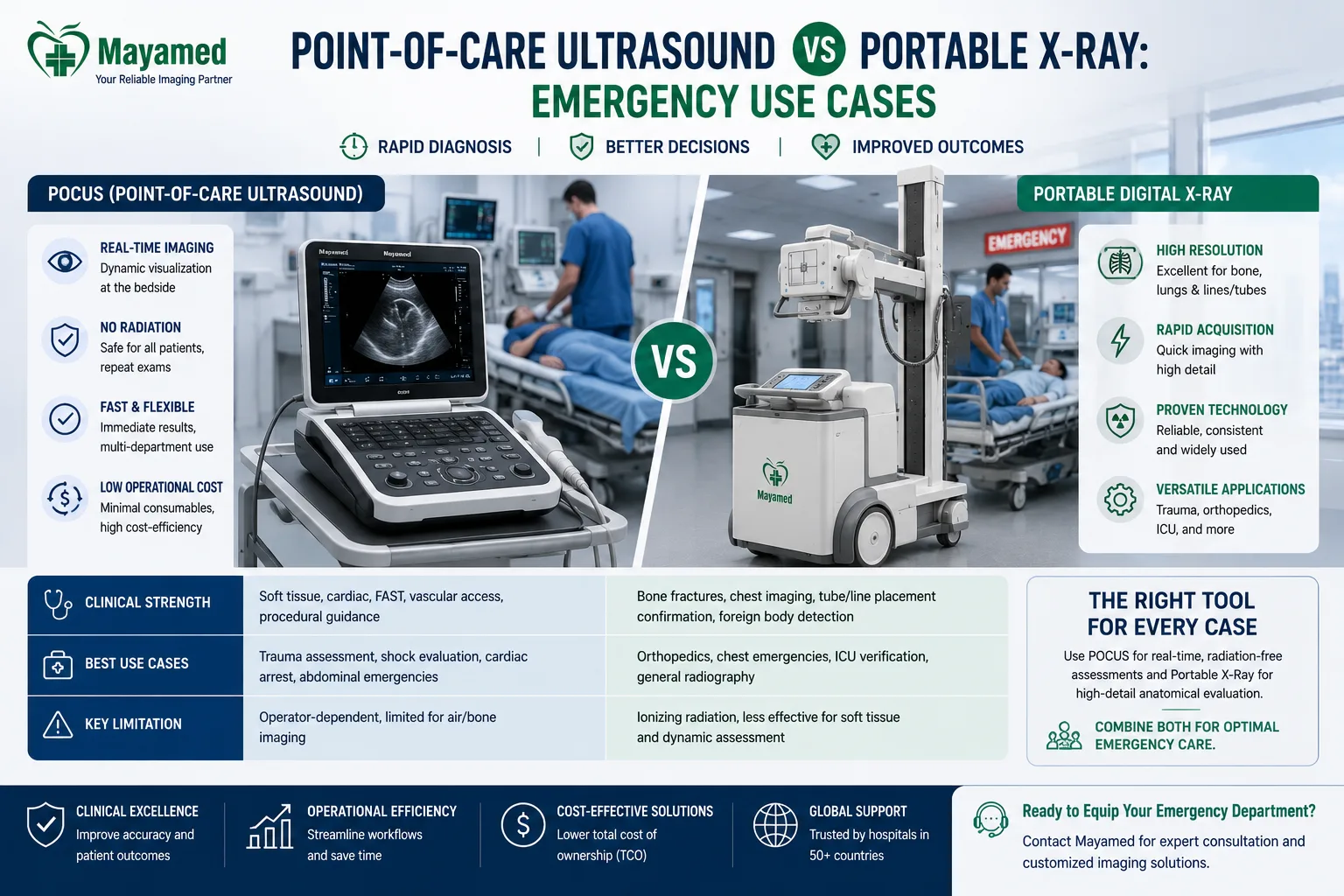
Choosing between point-of-care ultrasound (POCUS) and portable digital radiography requires a careful evaluation of clinical utility, operational efficiency, and total cost of ownership. This guide delineates the key differences to help you optimize your emergency department's imaging capabilities.
⚖️ Technology Comparison
POCUS vs Portable X-Ray Systems
| Feature | POCUS (Point-of-Care Ultrasound) | Portable Digital X-Ray |
|---|---|---|
| Clinical Utility | Real-time dynamic imaging, soft tissue, cardiac, and FAST exams | Static high-resolution imaging, bone fractures, and chest line/tube verification |
| Workflow & Speed | Immediate bedside visualization with zero radiation prep time | Rapid image acquisition, though requires radiation safety protocols |
| Operational Cost | Low cost per exam; reusable transducers and minimal consumables | Moderate cost per exam; includes detector maintenance and potential CR/film costs if not fully DR |
| Safety Profile | Non-ionizing radiation; safe for repeated use, pregnancy, and pediatrics | Ionizing radiation; requires lead shielding and strict dose monitoring |
📱 Portable vs Fixed Systems
Portable Modality Advantages:
- ✅ Bedside imaging for critical care and trauma patients, minimizing transport risks
- ✅ Multi-departmental flexibility (ED, ICU, OR)
- ✅ Lower initial capital expenditure (CapEx) and reduced facility footprint
- ✅ Rapid deployment in mass casualty or patient overflow scenarios
Fixed System Advantages:
- ✅ Superior spatial resolution and consistent image quality
- ✅ Higher patient throughput for high-volume radiology departments
- ✅ Advanced automated positioning and dose-reduction features
- ✅ Better long-term ROI for facilities with dedicated, high-traffic imaging suites
🏆 Top Manufacturers Comparison
- GE Healthcare: Industry leader with a comprehensive imaging portfolio; commands premium pricing but offers robust ecosystem integration.
- Siemens Healthineers: Renowned for precision engineering, advanced automation, and seamless PACS/RIS interoperability.
- Philips Healthcare: Highly intuitive user interfaces with strong AI-driven clinical decision support tools.
- Canon Medical: Delivers highly reliable performance with competitive lifecycle costs and strong global service networks.
- Fujifilm: Exceptional flat-panel detector technology yielding superior image quality at optimized dose levels.
🔬 Technical Excellence & Compliance
Procuring equipment with advanced technical specifications ensures diagnostic precision and regulatory adherence. All tier-one systems comply with stringent global standards, including ISO 13485 for quality management, CE (MDR) for the European market, and FDA 510(k) clearance for the US market.
🌍 Optimized for Emerging Markets
Designed with global infrastructure adaptability in mind, modern portable imaging solutions feature:
- Voltage Stability: Wide voltage input tolerance (110V-240V) with integrated surge protection to safeguard against unstable power grids.
- Climate Resilience: Enhanced thermal management and cooling systems engineered for high-ambient temperature environments (up to 45°C/113°F).
- Dust & Humidity Protection: IP-rated internal components ensuring operational longevity in challenging, resource-limited conditions.
Conclusion
Investing in high-quality portable imaging modalities is essential for delivering superior, time-sensitive patient care. By carefully weighing the clinical advantages of POCUS against the anatomical detail of portable X-ray—and balancing these technical requirements with your facility's budget and workflow constraints—you can procure a solution that drives operational excellence and improves patient outcomes.
🚀 Ready to Upgrade Your Imaging Department?
With over a decade of global export expertise and a successful deployment footprint across 50+ countries, Mayamed delivers high-performance medical imaging solutions optimized for both clinical excellence and budget efficiency.
- ✅ Complimentary technical consultation & facility site planning
- ✅ Comprehensive warranty packages & 24/7 remote technical support
- ✅ Expedited global shipping, customs clearance, & installation guidance
Contact our procurement specialists today for a customized, no-obligation quote!