Refurbished CT Scanner Comparison: GE vs. Siemens vs. Philips | Procurement Guide
Introduction: Strategic Capital Allocation for Modern Imaging Departments
The global shift toward value-based healthcare has accelerated demand for certified refurbished ct scanner platforms. Rather than accepting outdated hardware, modern procurement strategies prioritize pre-owned systems that deliver near-new clinical performance at 40–60% lower capital expenditure. For facility managers evaluating a comprehensive buying decision guide, the challenge lies in balancing technical specifications, serviceability, and regional infrastructure compatibility. This product comparison isolates the critical engineering and operational factors that determine long-term ROI.
Core Technical Parameters for Evaluating Used CT Scanner Brands
Before comparing OEM ecosystems, procurement teams must establish baseline technical requirements. A reliable refurbished ct scanner should meet or exceed the following clinical and engineering thresholds:
| Parameter | Clinical/Operational Benchmark | Procurement Note | |:---|:---|:---| | Detector Architecture & DQE | 64–128 rows; DQE ≥ 70% at 70 kVp | Higher DQE directly correlates with low-dose capability, critical for pediatric and high-volume trauma imaging. | | Spatial Resolution | 0.23–0.35 mm at isocenter | Ensures fine vascular and musculoskeletal detail without compromising scan speed. | | Gantry Rotation Speed | ≤ 0.35s (cardiac protocols); ≤ 0.5s (standard) | Faster rotation reduces motion artifacts and supports high-throughput emergency workflows. | | Reconstruction Engine | Iterative/AI-based (e.g., ASIR-V, ADMIRE, iMR) | Lowers radiation dose by 40–60% while maintaining diagnostic confidence. | | Power Requirements | 40–80 kVA, 3-phase, 50/60 Hz | Verify facility electrical capacity; older installations often require transformer upgrades. | | DICOM & PACS Integration | DICOM 3.0 compliant, HL7 support, vendor-neutral archive ready | Ensures seamless interoperability with existing hospital IT ecosystems. |
GE vs. Siemens vs. Philips: A Direct Product Comparison
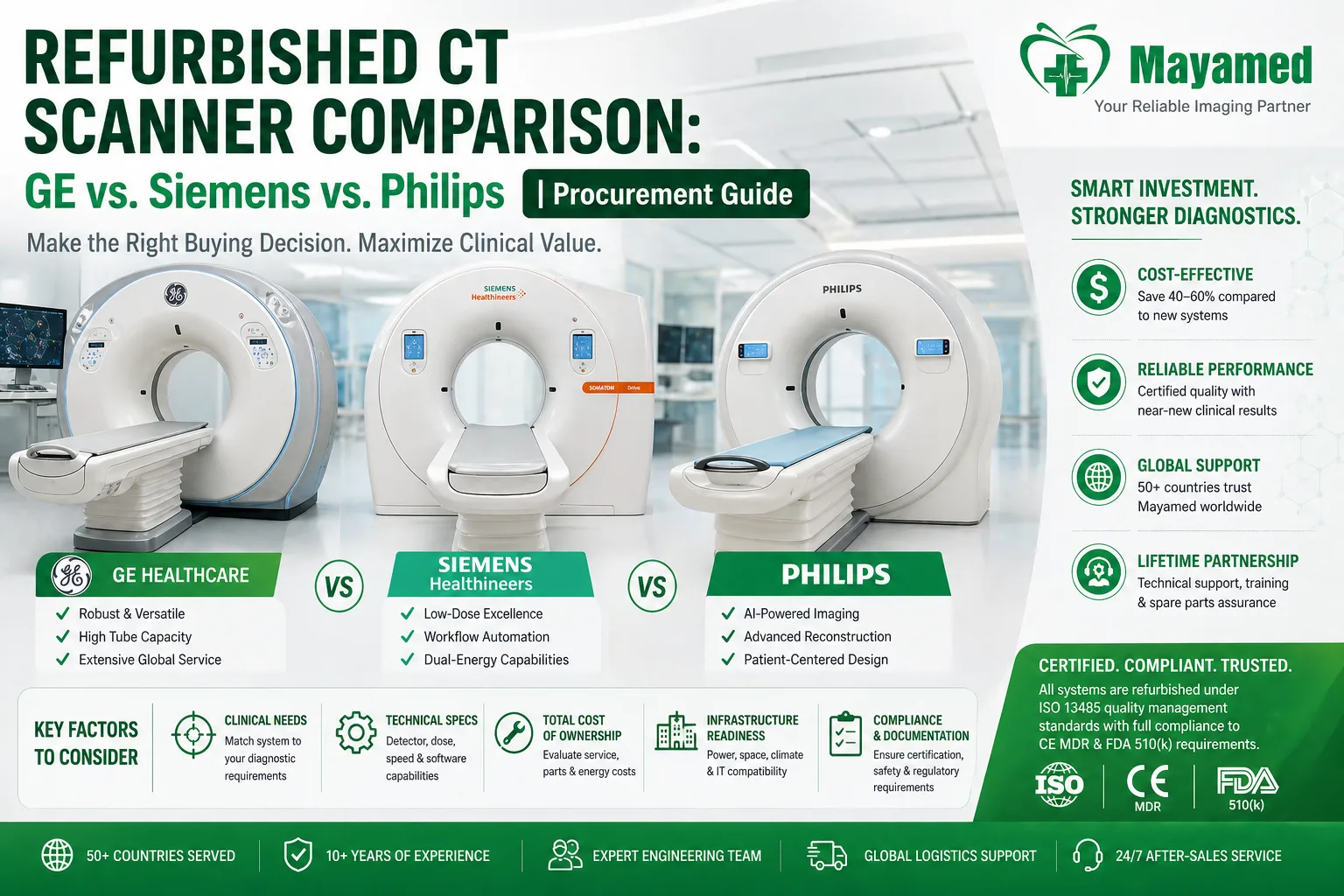
While all three manufacturers dominate global imaging markets, their architectural philosophies and service ecosystems differ significantly. Understanding these distinctions is essential when evaluating ge ct scanner price points against siemens ct scanner cost and total cost of ownership.
GE Healthcare: Clinical Versatility & Global Serviceability
GE’s Optima and Revolution series are engineered for broad clinical applicability. The platforms feature robust X-ray tube designs with extended anode heat capacity, making them highly resilient in high-volume settings. GE’s global service footprint ensures rapid spare parts availability, which significantly reduces downtime. Refurbished GE units typically command a 10–15% premium due to proven tube longevity and straightforward service architecture.Siemens Healthineers: Low-Dose Engineering & Automated Workflows
Siemens’ SOMATOM line emphasizes dose optimization and workflow automation. Proprietary tin filtration and dual-energy capabilities are often available even in certified refurbished configurations. The system’s automated patient positioning and protocol optimization reduce operator variability, making it ideal for facilities with rotating technologist staff. When analyzing siemens ct scanner cost, factor in the long-term savings from reduced repeat scans and optimized consumable usage.Philips Healthcare: AI-Driven Reconstruction & Ergonomic Design
Philips Ingenuity systems prioritize user-centric console design and advanced AI reconstruction algorithms. Their iDose and IMR engines deliver exceptional low-contrast detectability, particularly valuable in oncology and neurology. The open-gantry design and intuitive workflow reduce patient claustrophobia and technologist fatigue. Ge ct scanner price comparisons often overlook Philips’ software licensing flexibility, which can lower long-term operational overhead.Infrastructure Adaptation for Emerging Markets (Africa, LATAM, Middle East)
Deploying advanced imaging equipment in regions with variable grid stability and extreme climates requires engineered adaptations. Standard OEM specifications often assume controlled hospital environments; successful installations in emerging markets must address:
Voltage & Power Conditioning: Wide-input tolerance (380–415V/50Hz & 208–240V/60Hz ±10%) paired with inline voltage stabilizers and harmonic filters to protect sensitive detector electronics during grid fluctuations. Thermal Management: Extended chiller loops and high-capacity heat exchangers rated for continuous operation in ambient temperatures up to 45°C. Standard HVAC recommendations are often insufficient in arid or tropical climates. Environmental Sealing: IP54-rated control consoles and gantry air filtration systems to mitigate fine dust, sand, and high humidity (up to 80% non-condensing). Anti-corrosion coatings on external chassis components extend service life in coastal or industrial zones. Backup Power Integration: Seamless UPS and generator transfer switching (<100ms) to prevent tube quenching and detector calibration drift during power transitions.Navigating Compliance: ISO 13485, CE MDR & FDA 510(k) Standards
Procuring a refurbished ct scanner without verifiable compliance documentation exposes facilities to regulatory and clinical risk. Reputable suppliers must provide: ISO 13485:2016 certification for the refurbishment facility, ensuring standardized quality management across decontamination, component testing, and software validation. CE MDR (2017/745) conformity for EU-bound units, including updated clinical evaluation reports and post-market surveillance documentation. FDA 510(k) clearance verification for systems imported to or utilized in North America, confirming equivalence to original OEM specifications. Traceable service logs, tube mAs history, detector calibration certificates, and radiation safety testing reports. Always request third-party biomedical verification prior to shipment.
Buying Decision Guide: Aligning Technology with Clinical Volume
Selecting the right platform depends on your facility’s diagnostic mix and patient throughput. High-volume trauma centers should prioritize gantry speed and tube heat capacity. Specialized outpatient clinics benefit from AI reconstruction and dose-optimization features. Regardless of volume, verify that the supplier provides site readiness assessments, phased installation support, and remote diagnostic capabilities to minimize downtime during commissioning.
---
🚀 Ready to Upgrade Your Imaging Department?
With 10+ years of specialized export experience and active deployments across 50+ countries, Mayamed delivers certified refurbished ct scanner solutions engineered for clinical reliability and emerging-market infrastructure. We partner directly with hospital administrators, biomedical engineers, and procurement officers to ensure seamless integration from site planning to commissioning.
Why procurement teams choose Mayamed: ✅ Technical Site Audits & Power/Climate Readiness Planning ✅ ISO 13485-Certified Refurbishment & Full Compliance Documentation ✅ 24/7 Remote Diagnostics & Comprehensive On-Site Warranty ✅ Consolidated Logistics & Localized Installation Support📥 [Request a Custom Technical Specification Sheet & Site Checklist] 📞 Contact our imaging specialists today for a transparent, duty-optimized quote tailored to your region.