3T MRI vs 1.5T MRI: Image Quality, Cost, Clinical Applications & Buying Guide (2026)
📝 Article Summary
Compare 3T MRI vs 1.5T MRI systems in terms of image quality, clinical performance, installation requirements, operating cost, and long-term ROI. This guide helps hospitals, imaging centers, and procurement teams choose the best MRI solution for 2026.
Introduction
As healthcare providers continue investing in advanced diagnostic imaging, choosing between a 3T MRI scanner and a 1.5T MRI scanner has become a critical purchasing decision. While both systems support a wide range of clinical applications, differences in image quality, scan speed, operational cost, and infrastructure requirements can significantly impact long-term clinical ROI.
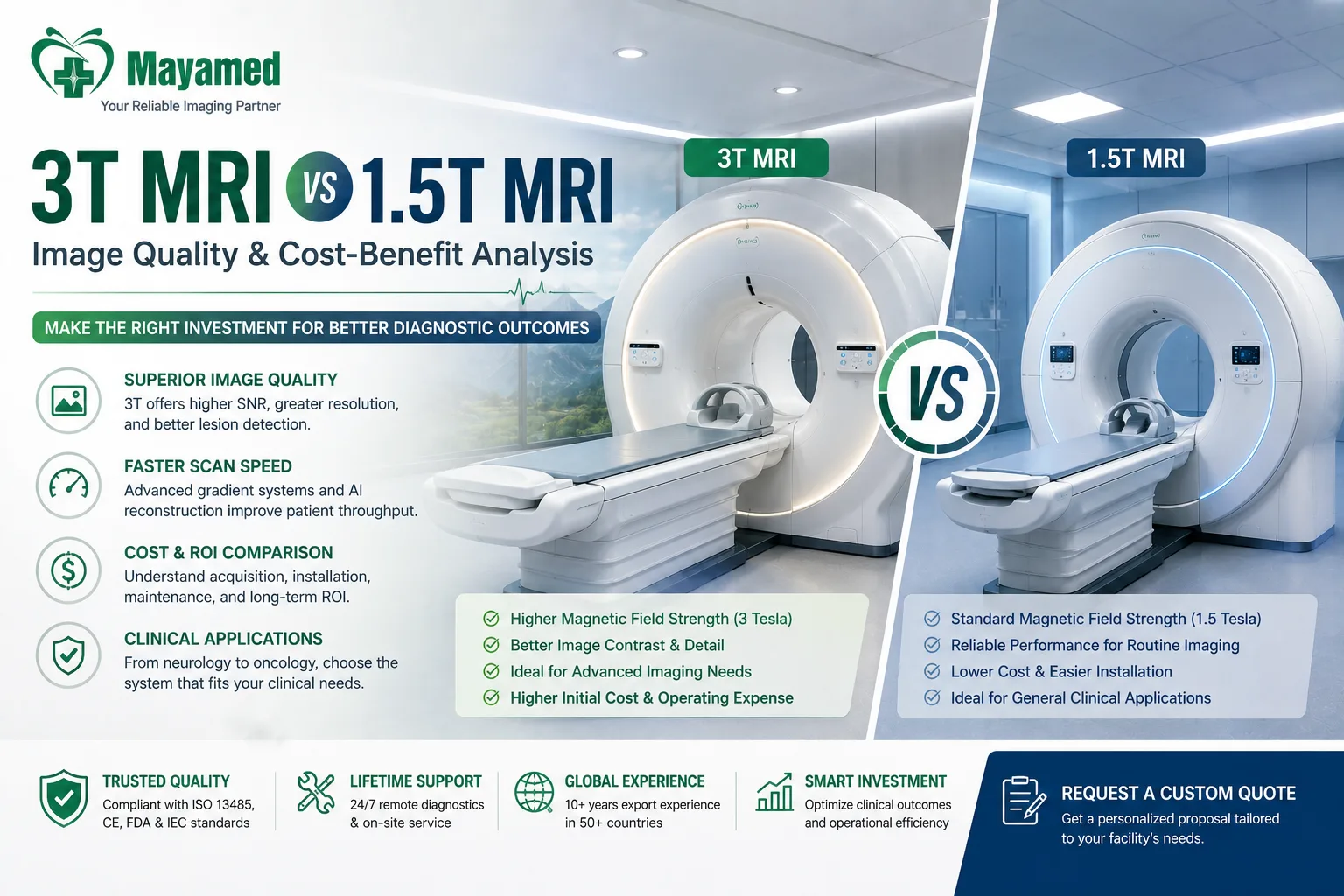
This comprehensive 3T MRI vs 1.5T MRI comparison guide outlines the key technical, financial, and operational considerations healthcare administrators, procurement teams, and radiology directors should evaluate before investing in a new or refurbished MRI system in 2026.
3T MRI vs 1.5T MRI: Key Differences at a Glance
| Feature | 1.5T MRI | 3T MRI |
|---|---|---|
| Magnetic Field Strength | 1.5 Tesla | 3 Tesla |
| Image Resolution | Excellent Standard Imaging | Higher Signal-to-Noise Ratio (SNR) |
| Scan Speed | Moderate | Faster Acquisition |
| Neurology Imaging | Good | Excellent |
| Cardiac MRI | Widely Used | Advanced Precision Imaging |
| Artifacts | Lower Susceptibility | Higher Susceptibility |
| Installation Cost | Lower | Higher |
| Maintenance Cost | Lower | Higher |
Image Quality Comparison
The primary advantage of a 3T MRI scanner lies in its higher magnetic field strength, which generates significantly greater signal-to-noise ratio (SNR). This allows radiologists to obtain:
- Sharper anatomical detail
- Higher spatial resolution
- Faster imaging protocols
- Improved small lesion detection
- Enhanced vascular and neurological imaging
In comparison, a 1.5T MRI scanner remains the global clinical standard for general imaging due to its balanced performance, lower artifact sensitivity, and reduced operating costs.
For hospitals prioritizing advanced neuroimaging, oncology, or research applications, 3T MRI image quality often delivers measurable diagnostic advantages. However, 1.5T systems continue to provide excellent clinical outcomes across routine orthopedic, abdominal, and musculoskeletal studies.
Clinical Applications: Which MRI System Is Better?
✅ Best Applications for 3T MRI
- Neurology & brain imaging
- Functional MRI (fMRI)
- Cardiac MRI
- Oncology imaging
- Vascular imaging & angiography
- Research hospitals & academic centers
✅ Best Applications for 1.5T MRI
- General radiology departments
- Orthopedic imaging
- Community hospitals
- Budget-sensitive facilities
- Emerging market installations
- Claustrophobic and high-motion patients
3T MRI Scanner Pricing Overview (2026)
Understanding the true cost of MRI ownership requires evaluating not only acquisition price, but also site preparation, maintenance, helium management, software licensing, and operational uptime.
| Category | Price Range (USD) | Best For |
|---|---|---|
| Certified Refurbished 1.5T MRI | $250,000 – $800,000 | Community hospitals & clinics |
| Refurbished 3T MRI | $750,000 – $1,250,000 | High-volume imaging centers |
| New Mid-Range 3T MRI | $1,250,000 – $2,200,000 | Multi-specialty hospitals |
| Flagship Research-Grade 3T MRI | $2,200,000 – $3,500,000+ | Academic medical centers |
Total Cost of Ownership (TCO)
📌 Site Preparation & Installation
- RF shielding and Faraday cage construction
- Quench pipe installation
- HVAC and chiller integration
- 3-phase power infrastructure
- Floor load reinforcement
- PACS/RIS integration
📌 Annual Maintenance Costs
- Preventive maintenance service agreements
- Helium refill and cryogenic servicing
- Gradient amplifier calibration
- RF coil testing and replacement
- Software upgrades & cybersecurity patches
- Remote engineering diagnostics
Compared with 1.5T systems, 3T MRI maintenance costs are generally higher due to increased cooling demands, gradient complexity, and advanced software ecosystems.
ROI & Patient Throughput Analysis
High-field MRI systems can improve departmental throughput by reducing scan acquisition times while increasing diagnostic confidence. Facilities deploying 3T MRI systems often benefit from:
- Shorter scan protocols
- Higher daily patient volume
- Premium reimbursement opportunities
- Reduced repeat imaging
- Expanded specialty imaging services
However, hospitals with moderate patient volume may achieve stronger ROI using 1.5T MRI systems due to lower operating costs and reduced infrastructure requirements.
Installation Requirements & Infrastructure Planning
Before purchasing a 3T MRI scanner, facilities must evaluate infrastructure readiness, especially in developing markets or retrofit environments.
Key Installation Considerations
- RF shielding and magnetic fringe field management
- Dedicated 3-phase electrical systems
- Closed-loop cooling systems
- Quench pipe routing compliance
- Structural floor load analysis
- Temperature and humidity control
Optimized for Emerging Markets
MRI systems deployed across Africa, Latin America, and the Middle East must withstand unstable power grids, elevated temperatures, and challenging environmental conditions.
- Voltage Stability: Integrated voltage regulators and UPS compatibility
- Thermal Resilience: High-capacity cooling systems rated up to 40°C ambient temperatures
- Environmental Protection: Humidity-controlled RF enclosures and IP-rated components
- Remote Diagnostics: Cloud-enabled service monitoring and predictive maintenance
Regulatory Compliance & International Certifications
All MRI systems should comply with international medical imaging standards, including:
- ISO 13485 Quality Management Systems
- IEC 60601-1 Electrical Safety Standards
- CE MDR Certification
- FDA 510(k) Clearance
- DICOM 3.0 & HL7 Compatibility
2026 MRI Industry Trends
- AI-assisted image reconstruction
- Helium-free MRI technology
- Cloud-based PACS integration
- Remote predictive maintenance
- Energy-efficient MRI systems
- Automated workflow optimization
Frequently Asked Questions (FAQ)
Is 3T MRI better than 1.5T MRI?
3T MRI generally provides higher image resolution and faster scan speed, particularly for neurology and advanced vascular imaging. However, 1.5T MRI remains highly effective for general clinical imaging and offers lower operating costs.
Does 3T MRI produce clearer images?
Yes. The higher magnetic field strength increases signal-to-noise ratio, allowing sharper anatomical detail and improved lesion detection.
Which MRI system is better for small hospitals?
For many community hospitals and regional diagnostic centers, a 1.5T MRI system offers the best balance between image quality, operating cost, and infrastructure requirements.
Is 3T MRI more expensive to maintain?
Yes. 3T MRI systems typically require more advanced cooling systems, higher power consumption, and increased maintenance complexity compared with 1.5T MRI systems.
Conclusion
Choosing between a 3T MRI scanner and a 1.5T MRI scanner requires balancing diagnostic performance, infrastructure readiness, operational efficiency, and long-term ROI.
While 3T MRI systems deliver superior image quality and advanced clinical capability, 1.5T MRI remains the most versatile and cost-effective solution for many healthcare facilities. By conducting a comprehensive high-field MRI comparison, hospitals and imaging centers can select a platform aligned with both clinical objectives and financial sustainability.
🚀 Ready to Upgrade Your MRI Imaging Department?
With over 10 years of international medical imaging export experience and installations across 50+ countries, Mayamed delivers high-performance MRI solutions engineered for reliability, compliance, and long-term clinical value.
- ✅ Complimentary RF room planning & workflow consultation
- ✅ New & certified refurbished MRI systems available
- ✅ Global shipping, installation & remote diagnostics support
- ✅ Flexible financing and trade-in programs
- ✅ OEM-equivalent warranty coverage
Request a customized MRI procurement proposal today.