Open MRI Machine: Benefits for Claustrophobic & Pediatric Patients
Introduction
As healthcare facilities prioritize patient comfort without compromising diagnostic accuracy, the demand for advanced open mri machine platforms continues to rise. This guide outlines the strategic, technical, and operational considerations procurement leaders must evaluate to optimize imaging throughput, ensure regulatory compliance, and deliver a superior clinical experience.
About Open Mri Machine
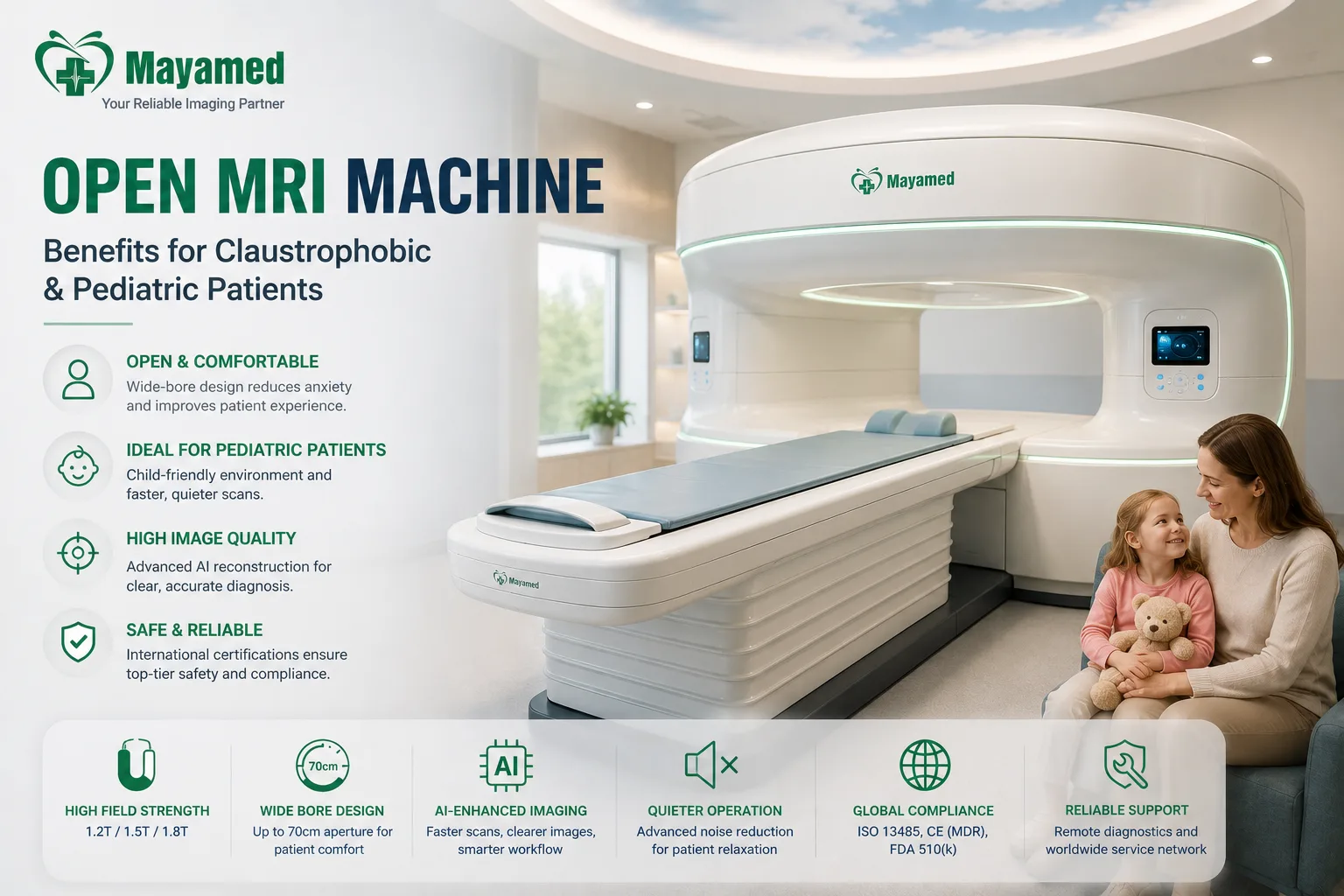
Modern open MRI systems have evolved significantly from early low-field designs. Today’s configurations, particularly the wide-bore mri scanner, deliver high-field performance within an expanded gantry aperture, effectively reducing patient anxiety while maintaining the spatial resolution required for complex neurologic, orthopedic, and pediatric imaging protocols.
For procurement decision-makers, understanding the intersection of diagnostic efficacy, infrastructure requirements, and total cost of ownership (TCO) is essential for capital planning that aligns with long-term institutional goals.
🚀 Industry Trends 2026
The open MRI landscape is shifting toward systems that maximize clinical throughput while minimizing lifecycle overhead:
- AI-Driven Reconstruction: Deep learning algorithms accelerate acquisition times and enhance signal-to-noise ratios without requiring higher field strengths.
- Helium-Optimized & Low-Maintenance Design: Next-generation sealed magnet and cryocooler technologies drastically reduce site preparation complexity and long-term servicing costs.
- Enterprise Connectivity: Seamless PACS/RIS integration with cloud-enabled remote diagnostics for predictive maintenance and uptime optimization.
- Patient-Centric Workflow: Advanced acoustic dampening, ambient lighting, and rapid sequence protocols improve scan compliance for pediatric and claustrophobic populations.
- Smart Automation: AI-assisted coil selection and automated table positioning standardize protocols, reduce technologist variability, and accelerate room turnover.
✅ Best Practices
- Vendor Qualification & TCO Analysis: Evaluate acquisition cost alongside 10-year service contracts, helium consumption rates, and guaranteed uptime SLAs.
- Preventive Maintenance Programs: Implement manufacturer-backed service agreements with tiered response times, remote diagnostics, and spare parts availability.
- Rigorous Quality Assurance: Establish daily phantom testing and quarterly physics reviews to maintain ACR compliance and consistent diagnostic fidelity.
- Infrastructure & Siting Planning: Conduct thorough pre-installation assessments for RF shielding, magnetic fringe fields, HVAC capacity, and structural load requirements.
- Staff Competency & Training: Secure comprehensive on-site application training during commissioning, with scheduled refresher modules for advanced protocol optimization.
⚠️ Common Challenges & Solutions
Budget Constraints
Solution: Evaluate TCO models, explore certified refurbished high-field systems, or negotiate performance-based leasing agreements with built-in technology refresh pathways.
Space Limitations
Solution: Opt for compact-footprint wide-bore designs with optimized RF shielding that reduce construction costs and integrate seamlessly into existing imaging suites.
Staff Training & Workflow Adoption
Solution: Require vendors to include structured on-site training, digital simulation modules, and ongoing clinical application support throughout the initial warranty period.
Technology Obsolescence
Solution: Select modular, software-defined platforms with guaranteed upgrade paths to support future AI reconstruction tools, advanced multi-channel coil arrays, and emerging clinical applications.
🔬 Technical Excellence & Compliance
Diagnostic-grade imaging requires uncompromising adherence to international regulatory and safety standards. All recommended platforms are engineered for clinical precision and fully comply with ISO 13485, CE (MDR), and FDA 510(k) clearance requirements. Systems feature IEC 60601-1 electrical safety certification, integrated quench management, and validated DICOM 3.0 interoperability for seamless enterprise integration.
🌍 Optimized for Emerging Markets
Engineered for reliable deployment across diverse global infrastructures, our solutions incorporate:
- Grid Resilience: Wide-input voltage tolerance (110V–240V) with integrated surge suppression and automatic voltage regulation for regions with inconsistent power delivery.
- Thermal Management: Redundant cooling architecture and closed-loop chiller systems designed for sustained operation in ambient temperatures up to 45°C.
- Environmental Durability: IP-rated RF shielding components and corrosion-resistant enclosures to ensure long-term reliability in high-humidity or dust-prone environments.
Conclusion
Strategic investment in a modern open mri machine—particularly a high-performance wide-bore mri scanner—directly impacts patient satisfaction, clinical throughput, and departmental ROI. By aligning technical specifications with rigorous procurement due diligence, healthcare administrators can deploy an imaging solution that scales with evolving diagnostic demands while maintaining fiscal responsibility and operational resilience.
🚀 Ready to Upgrade Your Imaging Department?
With 10+ years of global export experience and active installations across 50+ countries, Mayamed delivers high-performance medical imaging solutions engineered for clinical excellence and operational efficiency.
- ✅ Complimentary technical consultation & site readiness planning
- ✅ Comprehensive warranty, remote diagnostics & localized service partnerships
- ✅ Streamlined global logistics, customs clearance & turnkey installation support
Request a detailed specification sheet and customized procurement proposal today.