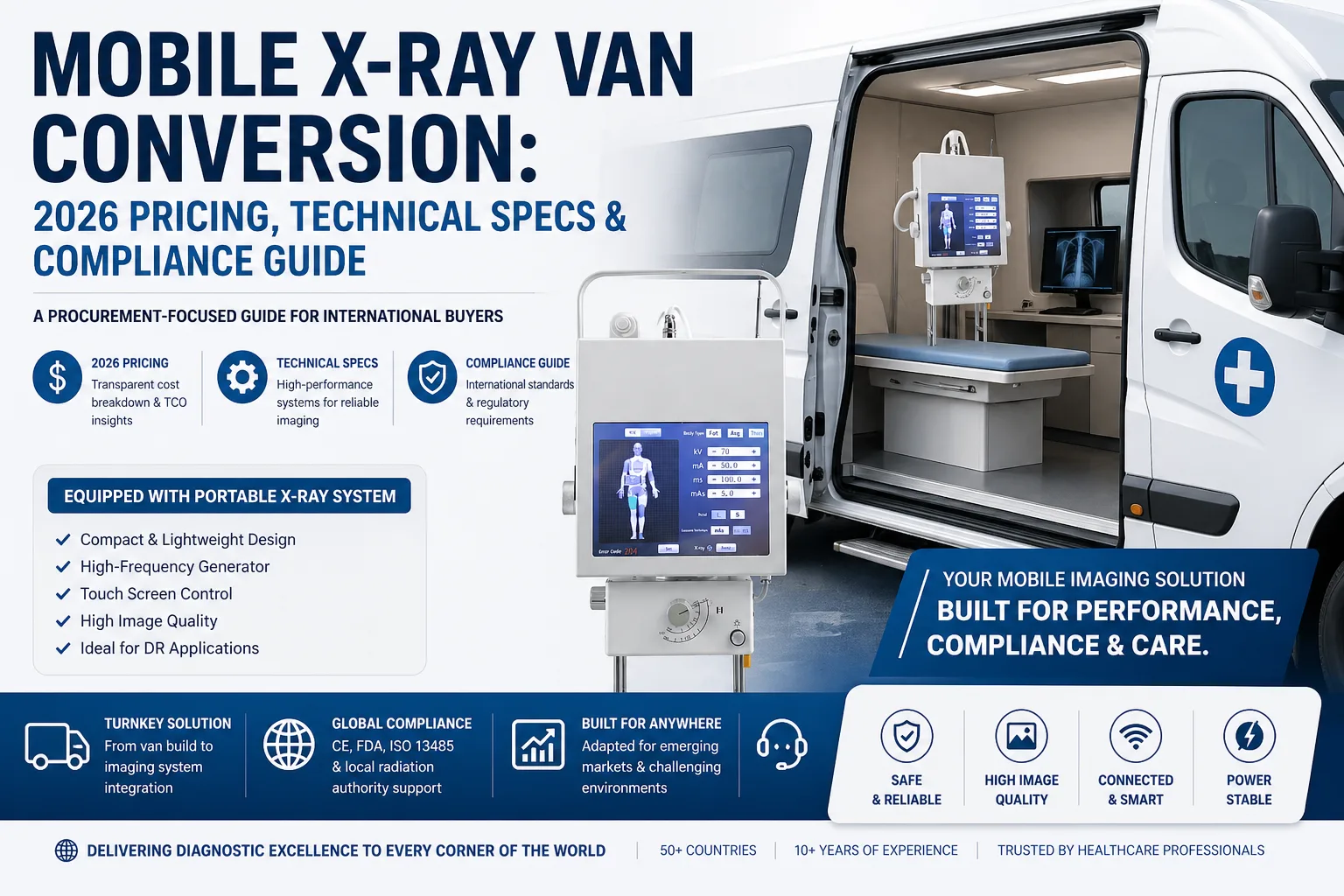
Mobile X-Ray Van Conversion: 2026 Pricing, Technical Specs & Compliance Guide
Introduction
Decentralized diagnostics are reshaping how healthcare systems deliver radiographic services. Rather than relying solely on fixed imaging departments, hospitals, NGOs, and regional health authorities are increasingly deploying mobile x-ray van solutions to reach remote clinics, disaster zones, and underserved urban populations. For procurement directors and biomedical engineers evaluating a mobile radiography unit in 2026, the decision extends far beyond sticker price. It requires balancing diagnostic accuracy, vehicle integration complexity, regulatory compliance, and long-term serviceability.
This guide outlines realistic x-ray van requirements, transparent pricing tiers, and engineering specifications tailored for international procurement. Whether you are outfitting a standard cargo van or commissioning a purpose-built diagnostic clinic, understanding the technical and financial landscape upfront prevents costly integration delays and ensures reliable clinical uptime.
2026 Pricing & Total Cost of Ownership
Budgeting for an x-ray vehicle conversion requires a holistic view of both capital expenditure and operational costs. The figures below reflect 2026 FOB/DDP market averages for complete, turnkey conversions including chassis modification, radiation shielding, integrated DR system, and compliance validation.
System Configuration & Price Tiers
| Configuration Tier | Price Range (USD) | Typical Deployment Scenario | |---|---|---| | Entry-Level (Cargo Van Retrofit) | $45,000 – $85,000 | Rural health outreach, veterinary networks, basic portable DR integration | | Mid-Range (Purpose-Built Clinic) | $85,000 – $180,000 | Community hospitals, regional screening programs, tele-radiography enabled | | High-End (Multi-Modality/Telehealth) | $180,000 – $350,000+ | Academic mobile units, disaster response fleets, integrated PACS & AI triage |
Note: Pricing varies based on chassis type (van vs. truck), detector matrix size, generator capacity, and regional compliance documentation.Total Cost of Ownership (TCO) Breakdown
Procurement teams should allocate 15–25% of the initial capital for first-year deployment and ongoing operational readiness:
Site & Chassis Preparation ($8,000 – $35,000): Structural reinforcement, lead-equivalent shielding (0.5–1.0 mm Pb), HVAC routing, and vibration isolation mounts for the X-ray tube. Annual Maintenance & Calibration ($4,000 – $18,000): Generator tube aging compensation, detector flat-field calibration, dosimetry verification, and preventive service contracts. Software & Connectivity ($1,500 – $6,000/yr): DICOM node licensing, PACS integration updates, cybersecurity patches, and remote diagnostic telemetry. Regulatory Recertification ($2,000 – $5,000): Annual radiation safety audits, IEC 60601 compliance verification, and local health authority inspections.New vs. Refurbished vs. Hybrid Conversions
Factory-New Systems: Full OEM warranty (2–3 years), latest DR detector architecture, predictable lifecycle costs, and seamless regulatory documentation. Certified Refurbished: 35–50% capital savings, reconditioned generators with new tube inserts, validated by ISO 13485:2016 quality systems, ideal for budget-constrained expansions. Hybrid Retrofit: Utilizes existing portable DR panels with newly engineered vehicle mounts and shielding. Lowest upfront cost but requires rigorous integration testing to avoid motion artifacts and shielding gaps.Technical Specifications & International Compliance
A mobile radiography unit must deliver consistent image quality regardless of vehicle vibration, ambient temperature, or power fluctuations. The following parameters represent the current industry baseline for reliable clinical deployment.
Imaging Performance & Power Architecture
DR Detector: Amorphous Silicon (a-Si) or CsI scintillator, 17"×17" (43×43 cm) active area, 143 μm pixel pitch, 16-bit grayscale depth. Detective Quantum Efficiency (DQE): ≥0.75 at 0.5 lp/mm, ensuring high signal-to-noise ratio at lower mAs settings for pediatric and dose-sensitive protocols. High-Frequency Generator: 30–40 kW output, 40–125 kV range, 10–630 mA, with rapid recharge (<5 sec) and exposure time accuracy of ±1%. Power Management: 3kVA–5kVA pure sine wave inverter with lithium or AGM battery backup. Auto-switching 100–240V AC, 50/60 Hz input with ±15% tolerance. Connectivity: Native DICOM 3.0, HL7/FHIR support, Wi-Fi 6 + 5G/LTE cellular failover for real-time tele-radiology transmission.Regulatory Certifications & Safety Standards
All compliant mobile x-ray van configurations should be accompanied by verifiable documentation: ISO 13485:2016 (Quality Management System for Medical Devices) CE Marking (MDR 2017/745) – Class IIb FDA 510(k) clearance (or recognized predicate equivalence for export markets) IEC 60601-1 & IEC 60601-1-2 (Electrical safety & EMC for mobile environments) IEC 60601-2-28 (Specific requirements for X-ray tube assemblies) Local radiation authority licensing (e.g., NRPB, ANVISA, SFDA equivalents)
Infrastructure Adaptation for Emerging Markets
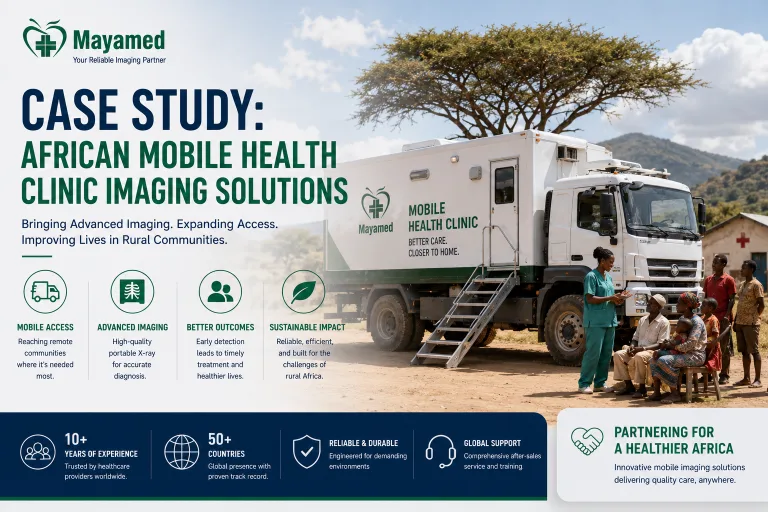
Deploying imaging equipment across Africa, Latin America, and the Middle East introduces unique operational challenges. Standard medical imaging packages often fail in regions with unstable grids, extreme ambient temperatures, or unpaved transport routes. Mayamed engineers every x-ray vehicle conversion with field-tested environmental hardening.
Power Stability & Voltage Management
Grid instability remains the leading cause of generator and detector board failure in emerging markets. Our mobile units integrate: Wide-Voltage Input Architecture: 110V–240V AC auto-sensing with Class II surge suppression and line isolation transformers. Smart UPS Buffer: 10–15 minute ride-through during grid dropouts, allowing safe exposure completion and system shutdown. Fuel-Optimized Inverter Mode: Reduces generator runtime by up to 40%, lowering noise, vibration, and diesel consumption during stationary operations.
Climate, Dust & Road Resilience
Thermal Management: Industrial-grade split HVAC systems rated for continuous operation in 45°C (113°F) ambient temperatures. Heat-dissipating tube housing and detector airflow channels prevent thermal drift during high-throughput screening. Environmental Sealing: IP54-rated control consoles, corrosion-resistant chassis coatings (salt-spray tested), and silicone-gasketed cable glands for dust and humidity protection in coastal or arid zones. Suspension & Mounting: Reinforced leaf-spring or air-ride suspension with anti-vibration gimbal mounts for the X-ray tube and detector. Tested to withstand sustained travel on unpaved roads common in rural Africa and Andean/Latin American terrain.Conclusion & Procurement Next Steps
Selecting the right mobile x-ray van requires aligning clinical performance with real-world operational constraints. By prioritizing DQE-optimized detectors, wide-voltage power architecture, and verified international compliance, procurement teams can secure a system that delivers diagnostic consistency, regulatory readiness, and predictable TCO across diverse deployment environments.
🚀 Ready to Deploy a Certified Mobile Radiography Unit?
Mayamed has spent 10+ years specializing in medical imaging exports, successfully delivering turnkey x-ray vehicle conversion packages to 50+ countries across Africa, Latin America, the Middle East, and Southeast Asia. Our engineering team pre-validates every unit for your target region's voltage, climate, and regulatory standards before shipment.
✅ Free technical consultation & site/van layout planning ✅ ISO 13485 & CE/FDA-compliant documentation package ✅ Remote calibration support & regional spare parts logistics ✅ Flexible financing & phased delivery options Request a customized quote or speak with our biomedical engineering team today: 📩 [[email protected]]| 🌐 [www.gzmayamed.com](https://www.gzmayamed.com) | 📞 WhatsApp/WeChat: +86-18925134082